Sunday, August 20, 2023

When Children Holocaust survivors lost the last links to their past.


Children were especially vulnerable to Nazi persecution. When World War II ended in 1945, six million European Jews were dead, murdered in the Holocaust. About 1.5 million of the Holocaust victims were children. The child survivors survived due to many different reasons. Many of them were full orphans.

Most of the children from Piotrków Trybunalski Ghetto were murdered in the death camp Treblinka in October 1942. At that Jewish families were rather large and in several, there were 8-9 siblings. 
Prior to and during the Action in the Piotrków ghetto Jews were trying to save the children by hiding them, both within and outside the ghetto borders.

However, after the Action, several children became half or full orphans. In several cases, relatives of the parents that were sent to death during the Action took care of the abundant children.

In the DP-2 cards of three persons of Rubinlicht's family that survived the Holocaust and were brought from Bergen-Belsen to Sweden by the UNRRA White Boat Mission and numerous other cards of the Bergen-Belsen survivors from Piotrków, we can follow the entire story of the family. Sisters of the mother Anna, Ruchla 19 year old end Estera, 24, were sent to the death camp Treblinka in 1942, Anna herself and her two daughters that were sent from Piotrków Ghetto to Ravnsbrück concentration camp in late 1944 and thereafter transported to Bergen-Belsen. Annas husband Pinkus Lajb Rubinlicht was transported first to Buchenwald and later transferred to Mittelblau Dora where he died just before liberation This was not mentioned in Anna Rubinlichts DP-2 card).

In December 19444, with mothers or with relatives children were transportet from Piotrków to the concentration camps Ravensbrück and Buchenwald and thereafter to Bergen-Belsen. When the Americans liberated Buchenwald concentration camp in April 1945, they found that about 900 children had survived thanks to the protection afforded to them by adult prisoners. Some of the children there were from the December 1944 transport from Piotrków. Some of the boys that came to Buchenwald with their father were separated from them and sent after 1 month to Bergen-Belsen.

Just before and some weeks before the liberation, numerous mothers or relatives died in the camp. 14 000 died after liberation between April 15 and the end of June 1945, This results that child survivors in many cases were losing their only links to the past. The youngest one had no idea about who their parents were and their surnames.

During the last deportation in December 1944, only 1-2 were following their parent or the caretaker.

On numerous DP-2 cards that were issued direcly after the war, the information about the child comes form the third person. It might be women that childs mother that shared a bunk at the concentration camp with childs mother that died shortly before och after the liberation of the camp. Often the information that comes from the child only at it contains just the nick names of mother and father.

It is likely that Icek become Ajsik after that letter I was prounced Aj and z as c. From Ajsik wich was a jewish name. 

On the photo below is Arie Fuchs. It is most likely that Leon change his name when arriving to Israel to Arie.  


Fuchs Arie

Saturday, August 19, 2023

Children's transport from Sweden to France Departure July 20, 1947 - Numerous children came to Sweden from Bergen-Belsen and Kinderheim by UNRRA mission White Boats.


Children's transport from Sweden to France Departure July 20, 1947 - Numerous children came to Sweden from Bergen-Belsen and Kinderheim by UNRRA mission White Boats. Numerous children are on the deportation list from Piotrków Ghetto to the concentration camp Buchenwald.


Thursday, August 17, 2023

Wilhelmówka, Zofjówka i Michałówka - Zużycie produktów spożywczych na koloniach TKL.


Na początku XX w. "Towarzystwo Kolonji Letnich" (TKL) posiadało już pięć własnych ośrodków zwanych „koloniami”. Wszystkie zostały sfinansowane przez prywatnych donorów. Dwie pierwsze – tzw. Wilhelmówkę i Zofiówkę (obie w guberni łomżyńskiej) – ufundowali spadkobiercy niemieckiego przedsiębiorcy W. E. Rau’a. Po wybudowaniu tych dwóch ośrodków Towarzystwo uznało za niezbędne powołanie specjalnej kolonii dla dzieci żydowskich. Tak powstała tzw. Michałówka (również w guberni łomżyńskiej), sfinansowana przez spadkobierców Michała Endelmana.

Janusz Korczak pracował na koloniach Wilhelmówka i Michałówka. Był również lekarzem dla dzieci Towarzystwa Kolonji Letnich.

Tuesday, August 15, 2023

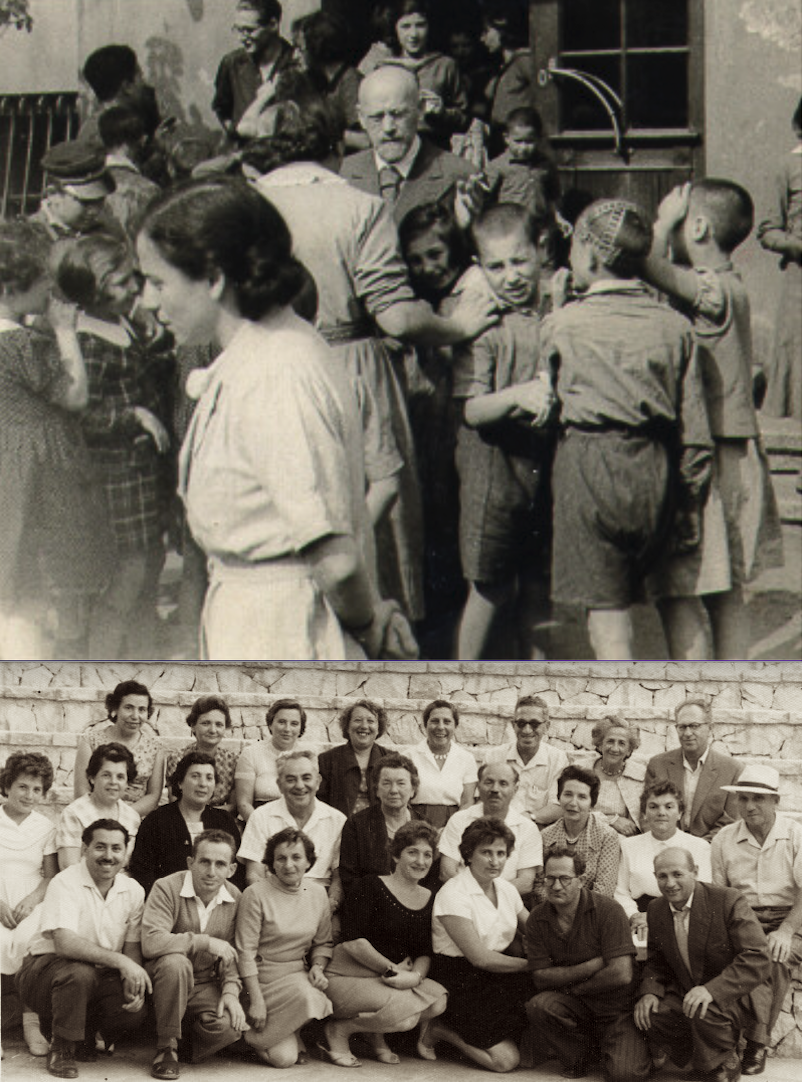
Dom Sierot - Izak Perla (Perła) w Warszawie i w Tel-Avivie - Korczak z papierosem - Wychowawcy: Pan Misza i Pan Szura - Czy Korczak był leworęczny?

Górne zdjęcie to Dom Sierot na Krochmalnej - Izak Perla (Perła) to trzeci chłopiec od prawej. Janusz Korczak z papierosem w środku. Wychowawcy: Pan Misza (tył głowy ) i Pan Szura w okularach na lewo od drzwi wejściowych.

Dolne zdjęcie to dzieci i wychowawcy po wojnie w Izraelu. Izak Perla (Perła) drugi od lewej. Pierwszy od lewej to Szlomo Nadel.

Trochę specjalne to to że Korczak trzyma papieros w lewym ręku. Czy był leworęczny?

Five important weeks for the UNRRA White Boat Mission 1945 - After negotiations between UNRRA, read the Allies, and Swedish Government, 10 000 Displaced persons were welcomed to Sweden. Among them, maximum 1 000 children were allowed to Sweden - Read "The Liberated 1945..." by Roman Wasserman Wroblewski - 2020.

Five important weeks for the UNRRA White Boat mission.

    After negotiations between UNRRA, the Allies, and the Swedish Government, 10 000 Displaced persons were welcomed to Sweden. Among them, a maximum of 1,000 children were allowed. Approximately this number of Displaced Persons likely came to Sweden. The mission goal was to partly empty the Bergen-Belsen emergency hospital. This emergency hospital was opened on 21 April 1945, and was the first to accept patients, former inmates of the concentration camp. Within the first four weeks, almost 29 000 survivors from the Bergen-Belsen concentration camp were moved to the emergency hospital that was slowly becoming one of the biggest DP camps.

    The main part of the persons that were transported during the UNRRA White Boat Mission came from Bergen-Belsen. However, when the stream of DPs that wanted to come to Sweden for hospital ward and rehabilitation diminished, the Swedish chef of the Transit Hospital in Lübeck decided to let other survivors from Bergen-Belsen be included in the quota of 10 000. Likely, the number of DPs that came to Sweden never reach this quota of a total of 10,000.

The Swedish authorities introduced the so-called Lübeck number, the letter L, and the number. It just concerns the Holocaust survivors who arrived with UNRRA's White Boats.

    Three DP-2 Cards are shown below. All of them have an L-number above 9500. The DP-2 cards were issued on July 23, 1945, the day of arrival at Swedish Transit Hospital, where all former inmates were registered and hospitalized until the day of departure. In the left upper corner, there is the DP-1 number from the very first registration as DPs. The L-number in the upper left corner is the number from the Swedish Entry card (Inresekortet) that was also filled and issued in Lübeck. In the lower part, in red is the name of the White Boat "Rönnkär" and the day of departure, here July 25, 1945. The passengers' list, the list of former inmates of the concentration camps, transported on the White Boats, always included the L-number.

    After arrival in Sweden, the medical card (Läkarkort) was issued to all the former inmates who arrived by White Boats. They were different at different Hospitals. Numerous hospitals had, on the cards, almost all possible numbers, including DP-1, DP-2, L-, and local hospital registration numbers. The L-number from the Swedish Entry card (Inresekortet) was the one that was most frequently included in the registration number.

    The very last two White Boats that left Lübeck on July 25, 1945, were S/S Kastelholm and M/S Rönnskär. S/S Kastelholm was specially reserved for the children, while the last DPs, among others from the Neustadt DP-camp.

    The group that came from the Neustadt DP camp was earlier inmates in the Stutthof concentration camp. The last person on the list with the L number 9529 was a German Jew who was sent with his family to Riga and from there to Stutthof. Chaim Kozieniecki 9516 and Leon Majerowicz 9519 were prisoners in Lodz Ghetto (Der jüdische Wohnbezirk in Litzmannstadt), Auschwitz, and Stutthof.  In February 1945, as the Soviet army approached, the inmates were taken on a death march, and finally on a barge on the Baltic Sea for almost 10 days to Neustadt, Germany. Chaim and Leon were liberated there by the American Army.

Swedish entry card L 9519 was issued for Majerowicz Leon (here called Lajb).

The L-number 9529 was the highest on M/S Rönnskär. The number 9346 was the highest on KP Ingrid. Children's numbering on S/S Kastelholm was between numbers 7769 and 7923. These three White Boats left Lübeck on July 1945. It was the end of the UNRRA White Boat mission. 


L-number was used as an identification number when transferring the children between the institutions in Sweden. Here are some children from the last trip of the White Boat S/S Kastelholm, where the list had the numbering between 7769 and 7923.


Monday, August 14, 2023

Not yet answered questions about the second biggest group of children, Holocaust Survivors from Sosnowiec-Będzin-Dandówka that came after WWII to Sweden by UNRRA White Boat mission.


As I reported earlier, the biggest group of children, Holocaust Survivors that came after WWII to Sweden by UNRRA White Boat mission was from Piotrków Trybunalski.
The second biggest was from Sosnowiec-Bedzin-Dandówka. Any idea why? How do these children survive? Their first camp was most probably Auschwitz and the last camp of these children, where they were liberated, was Bergen-Belsen. Three sisters Kalkop from Bedzin and two sisters Gerszonowicz and Bronka Frischer were in this group. See below the Swedish authority's search for the relatives.

The DP-2 card of Gerszonowicz Chava was issued at the Swedish Transit Hospital in Lübeck.

The DP-2 card of Gerszonowicz Rosa Róza was issued at the Swedish Transit Hospital in Lübeck.


List of passengers on the UNRRA White Boat to Sweden in July 1945.

Swedish authority's search for the relatives.


Sunday, August 13, 2023

Mamma, moster och barnet som kom från Bergen-Belsen till Sverige - Familjen Morgensztern (Morgenstern) historia.


DP-2 kort av Sulamit Morgensztern, L:2574, som var patient på Karlstads beredskapssjukhus. Det speciella är att hennes 11 åriga dotter, Morgensztern Awiwa, L: 7878, kom från Bergen-Belsen först 3 veckor senare med den sista Vita Båten som anlöpte Malmös hamn den 26 juli 1945. Dottern fanns i gruppen av sk Kinderheim barn och placerades på Sundsgården i Råå, utanför Helsingborg, drygt 450 km från Karlstad. När modern och dottern fick träffas är inte känt. De åkte serare, år 1947 till Frankriket och därifrån till USA.