Friday, October 6, 2023

Instytut Polski w Tel Avivie - Biblioteka


Instytut Polski w Tel Awiwie dysponuje bogatym zbiorem książek w języku polskim w wydaniach oryginalnych i tłumaczeniach. Oprócz bogatej kolekcji literatury pięknej jest tam również dział historyczny poświęcony zarówno historii Polski, jak i historii Żydów polskich. Obszerny zbiór hebrajskich przekładów literatury polskiej zaspokaja potrzeby Izraelczyków.

Biblioteka jest otwarta dwa dni w tygodniu.

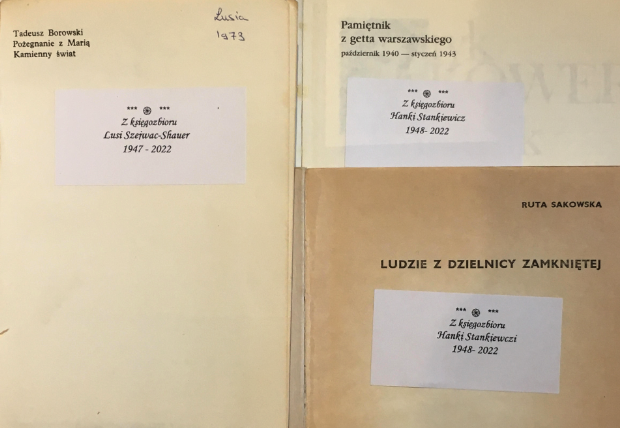
Podczas poniedziałkowej wizyty przegladajac pudła z ksiażkami które przynosza dzieci i wnuki Żydów polskich które już nie znaja polskiego znalazlem kilka ksiażek z naklejkami.

W rozmowie z p. Agatą Krizevski, bibliotekarką, dowiedziałem sie że to ona zrobiła i wkleiła te nalepki i że Instytut posiada już te pozycje. Wzruszony zabrałem do Szwecji trzy takie książki.


Tuesday, October 3, 2023

Aftermath of Kielce pogrom - Cooperation of Irgun Ha-Bricha and Polish Army - Midnight border crossings - "Jews cross frontier with connivance Polish and Czechoslovak border guards".

Luba Geller, an operative of "Irgun Ha-Bricha" with Polish army officers near the Polish-Czechoslovak border. In the photo:  Maj. Michal Rudawski (1st on the left), a Jewish officer, Maj. Michal Wasserman-Wroblewski (3rd on the left) and Maj. Tadeusz Chorawik (on the right). Photographed on July 30, 1946.

During five months 77 777 Polish Jews crossed the Polish-Czech border at a single place between Kudowa-Zdrój and Náchod. In Náchod the transit camp was set up where Jews stayed for a maximum 2-3 days.

goog_1748010996

From the Ghetto Fighters House Archives in Israel
An operative of "Irgun Ha - Bricha" with Polish army officers near the Polish - Czechoslovak border. In the photo: the operative Luba Geller (second from the left), Maj. Michal Rudawski (on the left), a Jewish officer; Maj. Wroblewski and Maj. Tadeusz Chorawik (on the right). Photographed on July 30, 1946.


goog_1748010996
Several Polish officers, some of them Jews were overlooking this gigantic operation - Michal Rudawski, Michal Wroblewski (Wasserman), and Tadeusz Chorabik. Two first mentioned were Jews. Here together with Luba Geller from Bricha.

Yitzhak Zuckerman "Antek" is in the middle with Lowa Lewite (in light coat) and Luba Geller (in raincoat). Luba and Lowa were Bricha emissaries from Mandatory Palestine. Lowa Lewite came to Poland from the kibbutz Ein Harod - a kibbutz that Janusz Korczak visited twice and was on his way to visit in September 1939 when WWII started. The officers in the photo are probably Czechoslovak, while the soldiers on the left and on the right are Polish soldiers.


During five months 77 777 Polish Jews crossed the Polish-Czech border at a single place between Kudowa-Zdrój and Náchod. In Náchod, the transit camp was set up where Jews stayed for a maximum 2-3 days.  In the photo, Jewish orphans from Poland arrive in Náchod in Czechoslovakia.

After Kielce pogrom, Irgun Ha-Bricha organized, together with the Polish Government and Polish army free passage from Poland to surrounding countries. The initiative came from General Marian Spychalski who was together with Icchak Cukierman - Yitzhak Zuckerman "Antek" taking part in the funeral of the Kielce pogrom victims. Several Polish officers, some of them Jews were overseeing this gigantic operation - Michał Rudawski, Michał Wroblewski (Wasserman), and Tadeusz Chorabik. The first mentioned were Jews.

"Irgun Ha - Bricha" [Hebrew: flight, escape] was a movement and organization for smuggling and transporting of Jews out of Eastern Europe to central and southern Europe, 1944 - 1948, with the ultimate objective of immigration to Palestine.

Up to 175,000 Jews left Poland at this particular action that started on July 20th, 1946 only weeks after the pogrom. It is likely that the action ended after diplomatic protests from the British who were at that time responsible for the Mandate Palestine. Polish general Gwideon Czerwinski was responsible for the entire mission.
Icchak Cukierman (Yitzhak Zuckerman) "Antek" on the left with Lowa Lewite, a Bricha emissary from Mandatory Palestine, when they were operatives of the "Irgun Ha - Bricha.". Lowa Lewite came to Poland from the kibbutz Ein Harod - a kibbutz that Janusz Korczak visited twice and was on his way to visit in September 1939 when WWII started.

How did everything start?
On July 4, 1946, Icchak "Antek" Cukierman (Yitzhak Zuckerman) took part in a meeting with Polish Prime Minister Edward Osóbka-Morawski. At one point of the meeting, the Prime Minister was called to the phone. When he returned, he announced to those gathered that a pogrom had taken place in the city of Kielce. Cukierman directly left the meeting and was the first to reach Kielce from Warsaw, bringing with him two trucks of medicines and other necessary supplies. 


The top row in middle - Icchak Cukierman (Yitzhak Zuckerman) "Antek" on his right Lowa Lewite, a Bricha emissary from Mandatory Palestine, when they were operatives of the "Irgun Ha - Bricha". Below is the group of Jewish orphans. The photograph was taken at the Polish Border Protection Forces.

Cukierman recalled:

I went out into the streets of Kielce, but the city was like a ghost town. I asked to be taken to the mortuary. I saw dozens of bodies. And new bodies of Jews murdered on the roads were still being brought. I saw pregnant women with their bellies ripped open. I cannot describe what I saw. But it wasn't 1942. It was 1946!

Cukierman on the way back from the funeral of the pogrom victims was returning with a government delegation. During this short flight, he talked to General Marian Spychalski. Spychalski during World War II belonged to the Polish underground forces operating within Poland and was one of the leaders of the People's Guard, then People's Army. During the Warsaw uprising in August 1944, Cukierman was the commander of a ŻOB unit fighting in the as they fought the Germans in the ranks of the People's Army (Armia Ludowa - AL). Cukierman´s small troop named after Anielewicz was composed of 322 survivors of the Warsaw Ghetto Uprising in 1943. They have known each other since that time. Year 1946 Spychalski was the Deputy Minister of Defense and a member of the Politburo of the Polish United Workers' Party. It was during this flight from Kielce that Cukierman gained an "emigration gate", actually gates on the border with Czechoslovakia. It was aimed for Polish Jews who wanted to leave/escape. Poland. Approx. 145,000 - 175,000 people took advantage of this opportunity that lasted for several months. It was the largest and for many years actively forgotten emigration of Polish Jews after World War II. Major Michał Rudawski who was overlooking this mission, actually controlled the Border Protection Forces. Also appointed to supervise the action was my father Michał (Wasserman) Wróblewski. At that time he was a "political officer" (probably placed at GZP Główny Zarzad Polityczny - Army Politburo). I don't know what this role was, but I assume it was to calm down those fellow officers and Polish soldiers who "didn't like" such an action or taking the economic advantages of, robbing the Jews at the border. Both my father and Michał Rudawski spoke fluently, Polish, Russian, and Jiddisch, and this knowledge and knowledge of the cities and pre-war shtetls as well as the fate of Jews during the Holocaust was important to solve the conflicts at the gates by short interrogations, checking how true were the stories. Opening the gates was of course an attractive way for non-Jews to leave Poland and get into the American or British zone of Germany and Austria. Polish army officers, Chorabik, Rudawski, and Wróblewski cooperated with two Bericha members Aleksander Charkowski and Luba Geller that were sent from Israel. It was important for all involved that the entire operation be kept secret, especially from the world press.

The Polish army cooperated with local Jewish committees that were actually responsible for the identification of unknown persons who came to crossing without documents. Representatives of Jewish committees were together with the Polish army planning exactly the day and hour of crossing. The groups of Jews often stayed at the places close to the crossing points, waiting for the signal.

Jewish committees were established after the war. They had different ranks (city, district, voivodeship) and were subordinated Central Committee of Jews in Poland (CKŻP). Central Committee of Jews in Poland was until Spring 1945 based in Lublin, and thereafter in Warsaw.

After passing the "gates" most of the Jews were directed to Bratislava, thus avoiding Prague, the Czech capital because both the Bricha and the Czech government were aware of British reactions. The British Ambassador to Prague lodged many protests demanding the closure of the borders, but the Czech government procrastinated. Polish Government and army were keeping the "gate mission" confidential, also for the Polish Foreign Office.

Transports of Jewish refugees kept arriving at the Czech borders and later also to Germany in spite of all the British and American protests to the Czech government. Most transports remained just a few days Czechoslovakia and continued their journey to Germany or Austria and hence to Italy or France for the refugees to board illegal ships and head to Palestine. Many Jews went also to the DP-camps and also Children facilities for the Jewish orphans and arrived to the Eretz later within the British Mandate quota of legal immigrants or after the rebirth of Jewish state in 1948.

Jews arrived at the Polish border in small groups, many by truck, and some on Polish trains that stopped at the last railway station on the Polish side. The refugees went to a pre–arranged meeting point where the Bricha guides were waiting to take them across the borders in small groups. Most of the Jewish refugees crossed the border on foot while a few managed to cross aboard trucks. To start with the border was crossed by Jews from Lower Silesia*. Many of them were earlier planning their life in Poland. Numerous, were, however, there as they were planning to illegally cross the border (with help of Bericha).

Rudawski mentioned in his book the gate that led to place on the Czech side called Nachod. It had a god road there, close to the border. On Polish side the nearest city was Kudowa-Zdrój that had a train communication to Wrocław (only 94 km) that had train connection with the rest of Poland. During five months 77 777 Polish Jews crossed the Polish-Czech border at a single place between Kudowa-Zdrój and Náchod. In Náchod the transit camp was set up where Jews stayed for maximum 2-3 days. From Náchod there was also train communication. During the "gate mission" additional trains have been placed from Nachod to Bratislava. Nowadays, the bus journey time between Náchod and Kudowa-Zdrój is around 8 min and covers a distance of around 7 km.

Once the refugees reached the Czechoslovakian side, the small groups gathered at one of a few staging areas, either at the large camps the Czech government set up at Náchod or Broumow, or other smaller camps. The small Jewish refugee groups were then combined into larger groups and put on trains bound for Austria and Germany. Rarely did the groups spend more than a day at the camps, although sometimes two or three days were needed to organize the transports.

Once the Czech trains reached the Austrian or German border, the refugees disembarked, the Bricha divided again the refugees up into smaller groups that surreptitiously found their way across the Austrian or German borders. After crossing the borders in small groups, the Bricha transported further the survivors on trucks borrowed from UNRRA, the JDC, or the American Army.
Michał Rudawski described border crossings from Poland to Czechoslovakia 1946-1947 in his book entitled "My Foreign Country" (Mój obcy kraj). Actually, the book was initiated by me as I was often meeting Rudawski after my father and his wife Klara died at the beginning of 1993. The photo above was taken at the Polish Institute in Stockholm at the ceremony of decorating my father with a medal on his 80-ties birthday (October 1991).

Rudawski later described crossings from Poland to Czechoslovakia in his book entitled "My foreign country". Actually, the book was initiated by me as I was often meeting Rudawski after his wife Klara died. Our families stayed very close. Rudawski´s son, Włodek, several years younger than me could not understand at that time my curiosity. I wanted simply to know more about my own father, who died one month after Rudawski´s wife did.

Actually, Michał Rudawski opened my eyes for numerous historical happenings. I told my mother about my "interrogations" with Michał and suggested that they should work together on a book. Michał told his history and my mother wrote it down i a proper way. I got the very first copy of his book with the inscription To Hero Roman.

Telegram - CONFIDENTIAL

The Ambassador in Poland (Laneto the Secretary of State

WARSAW July 25, 1946—5 p.m.

[Received August 4—8:50 a.m.]
1144. 

1. Embassy has evidence Jews now leaving Poland illegally in great numbers via the Czechoslovak frontier, with the ultimate destination American zone, Germany. Rate prior to Kielce pogrom approximately 70 per week. Rate now 700 per day. Evidence indicates numbers involved may total 100,000.
2. According to an eyewitness account by Mary Gibbons, UNRRA Deputy Director General for Health, Welfare and Repatriation, who has just visited Czechoslovakia, Jews cross the frontier with the connivance Polish and Czechoslovak border guards and are transported by Czechoslovak railway to Bratislava. Here Soviets facilitate transit to the American zone Austria, and US military authorities, in Austria, sent them on to Germany.
3. JDC assists with food and other help in Czechoslovakia. Apparently, Jews so arriving all well provided with money.
Detailed information follows by air.

Repeated to Berlin as 181; Vienna as 21; London as 153.
Lane

How the "open gate" mission end?
Britain and the United States were demanding the closure of the borders. Wen they saw that their protests against the open borders were not succeeding, they decided to use another tactic. They put pressure on UNRRA and UNRRA used economical threat and direct measures on Poland and Czechoslovakia.

Poland. Rudawski describes a meeting between Józef Olszewski representing the political bureau at the Polish Foreign Office, him and major Chorabik. The meeting was arranged after Olszewski called General Gideon Czerwinski and wanted information about "open gates". Olszewski said that this arrangement at the border compromises Poland. Both majors answered that they are army officers and just fullfil given orders. The meeting took place during the first 10 days of February 1947. Some days later, in mid-February the gates were closed. It is likely that the decision was taken after the American and British and also by the UNRRA that was at that time very important deliver of food, trucks, tractors and horses to Poland. The economic support was so important for post-war Poland.

Czechoslovakia. Also the same factors were used concerning Czechoslovakia. After WWII ended, the Czechs had been assured that UNRRA would assume most of the costs of transportation, temporary lodging and food for the transient Jewish refugees. However, when the Czechs cooperated with Poland to let the Jews to pass the border and continue to Germany and Austria UNRRA refused to pay the bills concerning their transport of them.

At the same time the UNRRA office in Czechoslovakia readily paid transportation bills and other expenses for the transport of non–Jews while payment for the transport of Jews dragged on. UNRRA officials could easily determine which was which. Almost all the passengers on transports originating at the Polish borders heading toward Austria or Germany were Jewish refugees. The non–payment of the bills that increased the expenses of the Czech government was of course the way to put pressure to close the gates on the Czechoslovakian side.


The largest concentration of Jewish population in Poland after the war was in Lower Silesia (belonging to Germany before WWII). The idea of establishing a Jewish settlement in Lower Silesia was supported by the Polish government and central Jewish institutions.


תפילת נר של חנוכה

Iton Qatan - Little Newspaper (Hebrew) was a weekly comic for children and teens, edited by Jerachmiel Weingarten, a friend of Janusz Korczak. Several articles from Mały Przegląd (in Polish) were translated and published there. Here is the story by Korczak about the girl and her talk with the Chanuka candle.

Iton Qatan was published in Warsaw (Warszawa) during 1928 - 1929. In Issue No. 29 (57), 10 May 1929, there is an excerpt from Korczak's book, "Moski, Joski, i Srule": "Ba - Moshava" (at the summer colony), translated to Hebrew by Amazia Barlas, with a picture of Korczak from his childhood.

Iton Qatan - Little Newspaper (Hebrew) was a weekly comic for children and teens, edited by Jerachmiel Weingarten, a friend of Janusz Korczak. Several articles from Mały Przegląd (in Polish) were translated and published there. Here is the story by Korczak about the girl and her talk with the Chanuka candle.

Iton Qatan was published in Warsaw (Warszawa) during 1928 - 1929. In Issue No. 29 (57), 10 May 1929, there is an excerpt from Korczak's book, "Moski, Joski, i Srule": "Ba - Moshava" (at the summer colony), translated to Hebrew by Amazia Barlas, with a picture of Korczak from his childhood.

Monday, October 2, 2023

"Może ustawić się parami, wziąć chorągiewki, zaśpiewać marsza i ruszyć w drogę?  — Dokąd?  — Do Słońca" - Do Eretz?!

"Może ustawić się parami, wziąć chorągiewki, zaśpiewać marsza i ruszyć w drogę?  — Dokąd?  — Do Słońca" - Do Eretz?!


"Może ustawić się parami, wziąć chorągiewki, zaśpiewać marsza i ruszyć w drogę?  — Dokąd?  — Do Słońca" - Do Eretz?!

"Proszę pana, ja teraz pójdę i wezmę to słońce. Tak nizko jest. Idź chłopcze i weź słońce. Spróbuj... "


Pierwsza wersja "Do Słońca" - Izraelita numer 49 (2 grudnia 1904)

Tego ostatniego wieczora o ostatnim zachodzie urodziła się ostatnia bajka kolonijna, — dziwna bajka i niedokończona.

 „A może nie wracać do Warszawy? Może ustawić się parami, wziąć chorągiewki, zaśpiewać marsza i ruszyć w drogę?

 — Dokąd?

 — Do Słońca.

 „Długo iść będzie trzeba. Ale cóż to szkodzi? — Sypiać będziemy w polu, a na życie zarabiać. — W jednej wsi Geszel zagra na skrzypkach, i dadzą nam mleka. W drugiej wsi Ojzer powie wiersz lub Aron bajkę ciekawą, — i dadzą nam chleba. Gdzieindziej znów zaśpiewamy albo w pracy w polu pomożemy...

 „Dla kulawego Wajnraucha zrobimy wózek z desek i gdy się zmęczy, będziemy go wieźli.“

 „Będziemy szli długo, długo, — będziemy szli i szli i szli...

 — No i co? — niecierpliwią się chłopcy.

 Ale rozległ się nagle dzwonek, wzywający na ostatnią kolację, i bajka została niedokończona.

 A nazajutrz byliśmy już w drodze do Warszawy.


Iton Qatan -  Little Newspaper (Hebrew)  was a weekly comic for children and teens), edited by Jerachmiel Weingarten, a friend of Janusz Korczak. In Issue No. 29 (57), 10 May 1929, there is an excerpt from Korczak's book, "Mośki, Jośki, i Srule": "Ba - Moshava" (at the summer colony), translated to Hebrew by Amazia Barlas, with a picture of Korczak from his childhood.

Korczak - Dom Sierot - Children and Treblinka - Rachelly Roggel and her Holocaust art work.

Rachelly Roggel´s art language is of buttons and buttonholes on fabric. Her decorative works ambush unsuspecting visitors of all ages who reveal the stories of Holocaust trauma. In her latest artwork about Janusz Korczak and Children that was on the Korczak exhibit last month in Israel, I could easily see that the artwork is highly connected with the Treblinka death camp.


Rachelly Roggel´s art language is of buttons and buttonholes on fabric. Her decorative works ambush unsuspecting visitors of all ages who reveal the stories of Holocaust trauma. In her latest artwork about Janusz Korczak and Children that was on the Korczak exhibit last month in Israel, I could easily see that the artwork is highly connected with the Treblinka death camp.

In the similar way as in the Holocaust Memorial in Treblinka there are the names of the cities and towns from which Jews were transported to the Treblinka death camp. Rachelly Roggel has the children carrying the names.

There is also a direct memorial of Janusz Korczak - Henryk Goldszmit at the bottom om her artwork. It is represented by Korczak's spectacles. Korczak's spectacles were still on his desk when my father, Misha Wasserman Wroblewski returned in the evening to the orphanage, being working outside the ghetto on this day. My father gathered Korczak's papers, among others, Korczaks Diary and threw them into a suitcases together with Korczak's spectacles the only personal thing saved after him to the world.

Rachelly Roggel lives in Rehovot, Israel.

Saturday, September 30, 2023

Piotrków Trybunalski - Getto - Uratowana od wysłania do Treblinki bo znała się na maszynie do szycia z overlockiem - Opowiadanie Anetki..


Latem 1945 roku Anetka i jej mama przyjechały z obozu, później szpitala w Bergen-Belsen, akcją UNRRA "Białe Statki" do Szwecji. Tutaj ich pierwsza szwedzka zima 1945-1946. Anetka i jej mama stoją pierwsze z lewej- Obok nich dwie siostry Rubinlicht (Tusia i Ruta) ze swoją mamą, Anną. Drugi od prawej Dąbrowski (father of Moniek Dabrowski).

Likwidacja getta w Piotrkowie rozpoczęła się w nocy z 13 na 14 października 1942 roku. Do 21 października Niemcy wywieźli do obozów zagłady około 20 000 osób. W Piotrkowie zostawiono około 2 000 wyselekcjonowanych robotników z huty szkła i fabryki na Bugaju. Część osób przeżyła akcję w ukryciu: w bunkrach, na strychach.

Wsród "wyselekcjonowanych robotników" znalazła się Sierpińska Chana (Hanka), ciocia Anetki. Pracowała "na overloku" w zakładzie produkującym mundury czy też inne tkaniny dla Wehrmachtu. Maszyny do szycia z overlockiem są skomplikowane albowiem overlock szyje za pomocą dwóch igieł i wielu nici - najczęściej trzech, czterech lub pięciu, specjalnie je zapętlając*. Ciocia Anetki wiedziała jak nawlekać nici i ustawiać maszynę. Dzięki temu pozwolono jej siostrze i nowonarodzonej we wrześniu siostrzenicy pozostać w Piotrkowie podczas akcji deportacyjnej do Treblinki w październiku 1942 roku.

Dwa lata pózniej, w grudniu 1944 deportowano dwuletnią Anetkę i jej mamę do obozu Ravensbrück a stamtąd do Bergen-Belsen. Wyzwolone w kwietniu 1945 przyjechały akcją UNRRA, Białymi statkami do Szwecji.

Gdy rozmawiałem z Anetką Niechcicką (teraz Kaufman) urodzoną w 1942 roku w getcie w Piotrkowie Trybunalskim. opowiedziała że jej ciocia, Sierpińska Chana (prawdziwy rok ur. nieznany 1916-19) została wywieziona do Auschwitz w grudniu 1944 i tam wyzwolona. Sierpińska Chana miała wytatuowany nr. obozowy i była wśród wyzwolonych w styczniu 1945 roku w samym KL Auschwitz. Po wojnie w Łodzi wyszła za mąż (Sztajn). W 1948 roku Anetka i jej mama przyjechały ze Szwecji do Polski i spotkały "specjalistkę od overloku". W latach 50-tych obydwie siostry z mężami wyjechały do Izraela.

* Ściegi wykonane za jego pomocą są mocne i elastyczne, idealnie nadają się więc do wykańczania brzegów i zabezpieczania ich przed pruciem.
** Na listach deportacyjnych z Piotrkowa Trybunalskiego w grudniu 1944 do Ravensbrück (kobiety i ich dzieci), jest m.in Niechcicka Maria z d. Sierpińska i Anetka Niechcicka).

Wsród "wyselekcjonowanych robotników" podczas selekcji w 1942 roku, znalazła się Sierpińska Chana (Hanka), ciocia Anetki. Pracowała "na overloku" w zakładzie produkującym mundury czy też inne tkaniny dla Wehrmachtu. Ciocia Anetki wiedziała jak nawlekać nici i ustawiać maszynę overloku. Dzięki temu pozwolono jej siostrze i nowonarodzonej we wrześniu siostrzenicy (Anetce) pozostać w Piotrkowie podczas akcji deportacyjnej do Treblinki w październiku 1942 roku.

Thursday, September 28, 2023

Museum om Förintelsen i Stockholm och Holocaust museum Yad Vashem i Jerusalem - under samma vecka i september 2023.

Yad Vashem - Hur många flyende tyskar och tyska nazister har transporterats i denna bus? Troligen betyligt fler än judar. De judar som kom till Sverige kom med de absolut sista bussarna. Bra att denna bus i Israel har lagts i en malpåse. Tidigare har den svenska statspropagandan gjort gällande att aktionen Vita bussar var för att rädda judar. Vita bussar har även tjänat direkt Gestapo med förflyttning av bl.a. franska, belgiska och polska POWs. Även Yad Vashem trodde på renheten i Vita buss historien i flera år! Bussen var en bra reklam för företaget Volvo och Sverige. Nu står bussen gömd i ett garage i Jerusalem. Bra tycker jag!

Stockholm - Det var roligt i gettot säger Elisabeth Citrom om hon ställs inför frågan Hur var det i gettot? Se för jämförelse bilden nedan av svältande barn i Warszawas Getto. Under tidsperioden, från november 1940, fram till den Stora aktionen i juli 1942 dog i Warszawas getto över 92 000 judar av svält och sjukdomar. Många av de barn. Vad skall målgruppen, svenska skolbarn tro, lära sig om Förintelsen efter sådana svar?


Undervisning om Förintelsen innebär en utmaning bl.a. därför att ämnet är stor och komplext.

Oftast börjar undervisningen, liksom utställningen, kronologiskt. Först handlar det om de avgörande stegen och besluten som ledde till den fysiska Förintelsen som började år 1941, i samband med aktionen Barbarossa. Barbarossa var Nazitysklands täcknamn för deras invasion av Sovjetunionen som startade den 22 juni 1941.

Ofta börjar man undervisningen om Förintelsen redan år 1933. I många fall även innan, t.ex. vid första världskriget och kopplar det starkt till antisemitismen (bra!). Materialet till den delen är enorm och Nürnberglagarnas införande år 1935 är bara en liten del i beskrivningen av nazisternas diktatur som började i januari 1933.

Kronologiskt upplagt är även den fantastiska utställningen i museet Yad Vashem utformad.  Yad Vashem är inte bara ett museum, det är Israels myndighet, monument, arkiv och ett forskningscentrum för "hågkomst av Förintelsens offer och hjältar", bildad genom ett beslut i Knesset år 1953. 
Då jag har varit där ett antal gånger, första gången år 1969, så tillägnar jag numera en hel del tid där att studera också besökarnas beteende. Detta sk hos ungdomar, skolklasser och unga soldater. De vikigaste målgrupperna

Den här gången har jag tittat på nivån av intresset i det enorma kronologiska utställningen i byggnaden som heter The Holocaust History Museum. Byggnaden är mycket lång, kanske hela 200-250 meter med en korridor i mitten och utställningssalar på båda sidor av den långa, uppifrån belysta, mittgången. Man zigzackar sig genom museet fram till utgången med en panoramavy över bergen runt Jerusalem. Denna beskrivning är viktigt då den är direkt kopplad till mina iakttagelser och slutsatser om besökarnas beteende och koncentration.

Hastigheten av besökarnas förflyttning och koncentrationsförmåga.
I de första salarna är hastigheten lägst och koncentrationsförmågan högst. I de salarna brukar det faktiskt vara mest folk. De första salar handlar om perioden före 1939, långt före andra världskrigets början. När man så småningom kommer till de andra salarna som handlar om den fysiska förintelsen är förhållandena omvända, besökarnas förflyttningshastighet är hög och koncentrationsförmågan låg. Orsakerna till det är många, både fysiska och psykiska. Detta gäller ej enbart ungdomarna. Jag guidade sist tre personer i åldern 70+ och med mycket starkt intresse för att ta del av utställningen då alla tre tillhörde sk Andra generationen. Även hos de upptäckte jag samma beteende som hos de israeliska ungdomarna. Salarna där det presenterades "Holocaust by bullets" med bl.a. Babij Jar och framfarten av Einsatzgruppen år 1941 var nästan tomma. Samma sak gällde kommande salar där den "Industriella Förintelsen" (1942-1944) visades.

Vad kan man göra?
Naturligtvis om en erfaren guide följer en ungdomsgrupp kan den uppdela besöket på det bästa tänkbara sättet så att helheten av Förintelsen kan tillskansas hos målgruppen. Det är ett stort ansvar.
För de enskilda, kanske första gång besökarna och de med låg grundkunskap om Förintelsen ett slags fysiskt "fast track" vore av intresse. Ett sådant skall innehålla det som man under vetenskapliga föreläsningarna kallar för "message to take home", det essentiella. Det kan man ordna på olika sätt. Det görs redan i en del konstmuseer.

Stockholm - Vad man inte bör göra i ett Förintelsemuseum.
 I Sverige finns ett Förintelsemuseum och en Myndighet som heter Levande Historia. I båda finns/fanns utställningar med anknytning till Förintelsen. Dyra att framställa som riktar sig oftast med sitt innehåll till en liten grupp av besökare, de involverade. Däremot saknas det en bra, riktad utställning om själva Förintelsen. Därför efterlyser jag en sådan fast utställning om Förintelsen i de båda statliga myndigheternas lokaler.  Utställningen skall rikta sig till skolungdomar! Även bra broschyrer, inte utställningskataloger, behövs där och naturligtvis rätt utbildade guider.

När jag såg tvenne gånger utstälningen i Museum om Förintelsen började jag undra vad är det som man sysslar med där. Inga bilder från getton, inga bilder från koncentrationsläger ingen direkt förklaring vad menas med FÖRINTELSEN.

Som jag påpekade inledningsvis så började det "kroppsliga, fysiska förintelsen av judar" med Holocaust by bullets år 1941 följd av den Industriella Förintelsen i dödsfabrikerna. 

Den mest kända aktionen inom Holocaust by bullets år 1941 var mordet på 33 771 judar (personer om man använder sig av Förintelsemuseets curling-beskrivningar).
Nedan ett förslag vad som bör visas istället för vackar höstbilder över en plats där massavrättning ägde rum 1941.


"Holocaust by bullets" i Stockholm. Utövar Museum om Förintelsen ett curlingföräldraskap?

Museum om Förintelsen i Stockholm. Hanna Brzezinska kom inte med Vita bussar till Sverige. Docent Roman Wasserman Wroblewski undersökte hennes öde som han beskrev 2021. Brzezinskas öde finns även beskrivet i en SVT-produktion från 2022 där man fastställer Wasserman Wroblewskis uppgifter.


Vad saknas och vad måste finnas i Förintelsemuseumet i Stockholm.

Det saknas allt man bör veta generellt om Förintelsen. Det finns några enskilda människoöden som säger, tyvärr, mycket lite om helheten.

Om Holocaust by bullets.

Fyra stationer skall påpekas i utställningen:
  • Samarbete med lokalbefolkningen och avhumanisering
  • Aktionsplanering med lokalbefolkningen
  • Einsatsgruppens manuella skjutningar
  • Sanering av platser för mördandet.
Babij Jar 1941 - Samarbete med lokalbefolkningen och avhumanisering


Babij Jar 1941 - Samarbete med lokalbefolkningen och avhumanisering


Sardinenpackung - ett system att mörda - skjuta lager efter lager av offren som Einsatzgruppe använde.


Om den Industriella Förintelsen.

Tre stationer skall påpekas i utställningen:
  • Samling i getton - första gettot redan i oktober 1939.
  • Transporter från getton till Förintelseläger . efter Wannesee mötet.
  • Förintelse i gaskammare. 
  • Bränning av kroppar
  • Sanering av Förintelselägren vid den rysak offensiven

Aktionen i Warszawas Getto startade 22 juli 1942. Tågen från Umschlagplatz i Warszawas getto gick direkt till dödslägret Treblinka där judar mördades i gaskammare.  Stora Aktionens deportationer till Treblinka resulterade i att 375 000 judar ur Warszawas Getto mördades i utrotningslägret Treblinka. På bilden hungriga barn i Warszawas Getto. Under tidsperioden, från november 1940, fram till den Stora aktionen dog i Warszawas getto över 92 000 judar av svält och sjukdomar.

Umschlagplatz i Warszawa. Härifrån förde man judar (huvudsakligen polska och tyska) till utrotningsläger Treblinka och Majdanek.  De flesta togs under den Stora Aktionen i Warszawas Getto under sommaren 1942 och därefter under Warszawaghetto upproret i april.maj 1943. Från Umschlagplatz fördes judar i boskapsvagnar till dödslägret Treblinka där de mördades i gaskammare.  I Treblinka mördades 375 000 judar ur Warszawas Getto.

Massgravar i Warszawas getto såg ut på samma sätt som de massgravar som tyska Einsatgruppen lämnade efter sig. Även här Sardinenpackung. De som dog i Warszawas getto var oftast offer för hunger och sjukdomar fast det förekom en hel del avrättningar. I den här hörnan av massgraven lägger man enbart kvinnor.
Planering av mördandet i Wannesee.


Avstigningsplatsen i förintelselägret Treblinka II såg bedrägligt fin och naturlig ut. Den falska stationsbyggnaden (2) hade gjorts så lik en riktig tågstation som möjligt. Man möttes av en stor skylt TREBLINKA och två mindre ”Väntsal” och ”Biljettexpedition”. Tidtabellerna fanns uppsatta på väggarna. Män, kvinnor och barn skildes åt direkt och fördes till avklädningsbarackerna (3). Vidare, drevs de nakna människorna med vrål och bajonetter längs en liten trädgårdsallé beströdd med sand kallad die Himmelstrasse – vägen till himmleriket. Himmelstrasse ledde till en byggnad (4) med tiotalet rum på femtio kvadratmeter. Vid ingången hängde ett stort skynke ”Detta är HERRENS port, de rättfärdiga skola gå in genom den”. Inne i byggnaden fanns det en mittgång med fem dörrar på vardera sidan. I en korridor stod en mängd blommor och på väggarna hängde handdukar - Duschrum. Ett duschrum som var en gaskammare. Man mördade upp till 15 000 människor på en dag. Gasningen tog cirka tjugo minuter i den äldre byggnaden och i den nya varade den i fyrtiofem minuter. Treblinka kom att bli det mest perfekta av nazisternas förintelseläger, en dödsfabrik med en högeffektiv produktion av lik med aska som slutprodukt. Den helt ”färdiga” askan skulle vara ren från minsta benfragment. Skissen ovan gjord av Treblinkas kommendant Franz Stangl (från Bundesarchiv).

15 April 1945, Bergen-Belsen. Många tidningar i Sverige har huvudsakligen publicerat bilder på glada fd fångar som börjar livet på nytt. Vid befrielsen av Bergen-Belsen har man hittat likhögar. De flesta judar som kom till Sverige var polska judar befriade från just det lägret. De kom med UNRRA Vita Båtar, inte som med hr. Bernadottes Vita bussar som Förintelsemuseet vill göra gällande gm att inte visa bilder på de fem Vita båtar som deltog i aktionen.

Förlorade röster, S/S Ulua och S/S Chaim Arlosoroff 
Förintelsemuseet vill göra gällande att deras senaste projekt som de nyligen sjösatte är deras projekt. Men det är Föreningen Förintelsens Minnes projekt från 2018. Det mesta i projektet är detsamma. Museum om Förintelsen servera också lögner att projektet initierades av Judiska församlingen i Stockholm. Detta trots att det finns en fullständigt dokumentation om projektet som Föreningen Förintelsens Minne lämnade till Stockholm Stad, Lunds Universitets rektor och Riksantikvarieämbetet (kan begäras från deras respektive registrator. Att inte nämna Föreningen Förintelsens Minne är att sälja stöldgods. 
Vad Museum om Förintelsen i Stockholm gjorde så döpte de om projektet och kör det som eget. Det finns en legend om att inte ostraffat döpa om båten. Den säger säger att havens gud och härskare Poseidon/Neptunus kan namnen på alla båtar som finns. Om man ändrar namnet utan hans tillåtelse så drar man på sig hans vrede. Man kan dock namnändra. Museum om Förintelsen följer noggrant hela omdöpningsprocessen som bl.a. går ut på att man får inte, under inga omständigheter, ha på båten (läs museet) några prylar märkta med det gamla båtnamnet "Föreningen Förintelsens Minnes projekt".
S/S Ulua och S/S Chaim Arlosoroff heter en och samma båt som förde de Överlevande från Sverige till Haifa år 1943. Besättningen, de överlevande och själva båten var detsamma när skeppet lämnade Trelleborg i januari 1943 och när den ankom till Haifa. Det som ändrades var namnet, från Ulua till Chaim Arlosoroff. Trots att den ankom som S/S Arlosoroff så hänvisar alla till ursprungsnamnet och ursprungshamnen.

Vad Museum om Förintelsen i Stockholm gjorde så döpte de om projektet och kör det som eget. Det finns en legend om att inte ostraffat döpa om båten. Den säger säger att havens härskare Poseidon/Neptunus kan namnen på alla båtar som finns. Om man ändrar namnet utan hans tillåtelse så drar man på sig hans vrede.