 | |
|
 |
| 19 names of Holocaust "refugees" who, during July-August 1945, became the first Holocaust victims buried in Stockholm. Zofia (Zophia på listan) Mendel and Frymet Ajnhorn (Einhorn Frimatta på listan) were the youngest, 15-16 years old. |
 |
| Frymeta Ajnhorn from Polska, Lodz, was 16 when she was liberated at Bergen-Belsen camp. She came to Stockholm on board the White boat S/S Kastelholm on June 5th, 1945. She died in Sigtuna hospital on August 7th, 1945. Her grave is in the K-section of Norra begravningsplatsen (Jewish cemetery) in Stockholm. Her name is misspelled on the gravestone after it was changed twice, both in Germany and thereafter in Sweden. Here is her Field Medical Card that she received in the Bergen-Belsen field hospital shortly after the liberation (April 15, 1945). The relatives of Frymet from Israel contacted me in the mid-nineties and asked me to find her grave. This evoked my interest in describing her and the fate of Holocaust victims during the Holocaust, including the Epilog at the Swedish cemeteries. |
Holocaust and WWII traces are found at cemeteries in Stockholm and at Jewish and Christian cemeteries in many other cities of this country.
There are numerous graves from former prisoners from concentration camps that came to Sweden after WWII and Holocaust ended with UNRRAs White Boats or at the and of April and beginning of May 1945 with White buses and White (Spoke) trains. In Sweden, Holocaust survivors received medical care, but numerous died almost immediately during 1945-1946, many as young as 13-14 years. These types of graves are in many places in Sweden where former camp prisoners received medical treatment, among others Malmö, Gothenburg, Kalmar, Örebro, Norrköping, Stockholm, and also on the island Gotland.
The evacuations known as the "White buses action" started on March 15, 1945, just 7 weeks before WWII officially ended. The first trips of the buses were, however, aimed at Nazi wives and children (approx. 1500) and first thereafter, for non-Jewish, Scandinavian inmates of the concentration camps.
Jewish, former prisoners from concentration camps; most of them came to Sweden by UNRRA's White boats. It was the Swedish Red Cross and UNRRA's action. Starting in late June 1945, UNRRA's Red Cross White boats sailed from Lübeck to several Swedish cities along the coastline. The former prisoners from concentration camps were taken to the special hospitals belonging to the Swedish Military organization (Beredskapssjukhus). Many patients survived for just a few days or weeks. Most of the patients were female and came from the Bergen-Belsen camp.
Numerous other Holocaust survivors who died after 1948 are buried in both the South and North Cemeteries at the usual graveyards.


There are numerous graves from former prisoners from concentration camps that came to Sweden after WWII and Holocaust ended with UNRRAs White Boats or at the and of April and beginning of May 1945 with White buses and White (Spoke) trains. In Sweden, Holocaust survivors received medical care, but numerous died almost immediately during 1945-1946, many as young as 13-14 years. These types of graves are in many places in Sweden where former camp prisoners received medical treatment, among others Malmö, Gothenburg, Kalmar, Örebro, Norrköping, Stockholm, and also on the island Gotland.
The evacuations known as the "White buses action" started on March 15, 1945, just 7 weeks before WWII officially ended. The first trips of the buses were, however, aimed at Nazi wives and children (approx. 1500) and first thereafter, for non-Jewish, Scandinavian inmates of the concentration camps.
 |
| Dora Ajzensztajn (not Eisenstein) was among the very first survivors who came with the UNRRA's White Boat - HMS Prince Carl to Norrköping / Kalmar. The White Boat left Lübeck on June 28, 1945. She was later transferred to the hospital in Stockholm. She turned 18 years old. The same type of tombstones, paid for by the Swedish State, were erected in numerous Swedish cities that received Holocaust survivors. Among others: Norrköping, Kalmar, Lärbro and Stockholm. Dora was buried in block J at the Northern Jewish Cemetery. |
 |
| Dora Ajzensztajn (not Eisenstein) was among the very first survivors who came with the White Boat - HMS Prince Carl to Norrköping / Kalmar. Departure from Lübeck on June 28, 1945. She was later transferred to the hospital in Stockholm. Dora was buried in block J at the Northern Jewish Cemetery. Her sister Chaja came to Sweden on another White boat. Her sister Chaja, born 1919 came to Malmö on White boat M/S Karskär on July 18th, 1945. |
 |
| Picture taken on May 29th, 1945, at Bergen-Belsen Camp. |
Numerous other Holocaust survivors who died after 1948 are buried in both the South and North Cemeteries at the usual graveyards.

6 THOUSAND OF 6 MILLION: A REQUIEM / Romuald Wróblewski, editor
| Authorship |
Wroblewski, Romuald.
|
|---|---|
| Edition: |
2nd Year: 1995 |
|
The book 6 TUSEN AV 6 MILJONER: ETT REQUIEM by Romuald Wróblewski et. al. includes a register of 6,000 Jews who perished during the Holocaust (p. 67-166). The book was published by the Swedish Holocaust Memorial Association (SHMA) in 1995 - 50 years after the end of the Holocaust and the liberation of camps, a.o. Bergen-Belsen.
The names listed in the book were for the Holocaust Monument. The names are the relatives of Holocaust survivors living in Sweden.
This particular list was gathered by Roman Wasserman Wroblewski during 1994-1995 and includes 6,000 names of Holocaust victims. Holocaust survivors and their families, now living in Sweden, provided testimony to compile the list. The list includes the name, birth year, birth place, death year, death place, and the name of the group or individual who submitted the entry (eg Holocaust survivor or Second Generation). The names come from Holocaust survivors born throughout Europe. The only connecting feature of the 6 000 is that their names were provided by individuals residing in Sweden as of 1995. The resulting listing of Holocaust victims was first prepared in electronic form, published in this book, and was thereafter inscribed on the Stockholm Holocaust Name Monument (memorial) itself.
Besides this list provided by survivors, the book includes a register of Jewish refugees who died in Sweden in 1945-1946 and the list of Jewish refugees who died while being transported to Sweden or shortly after arrival. The lists were obtained from the Red Cross and other organisations like the World Jewish Congress. All refugees who came with White Boats and White buses must be regarded as Holocaust victims.


Holocaust survivors that are listed in the above publication were from 12 countries in Europe, and there are several with "unknown nationality" and/or "unknown country of origin".
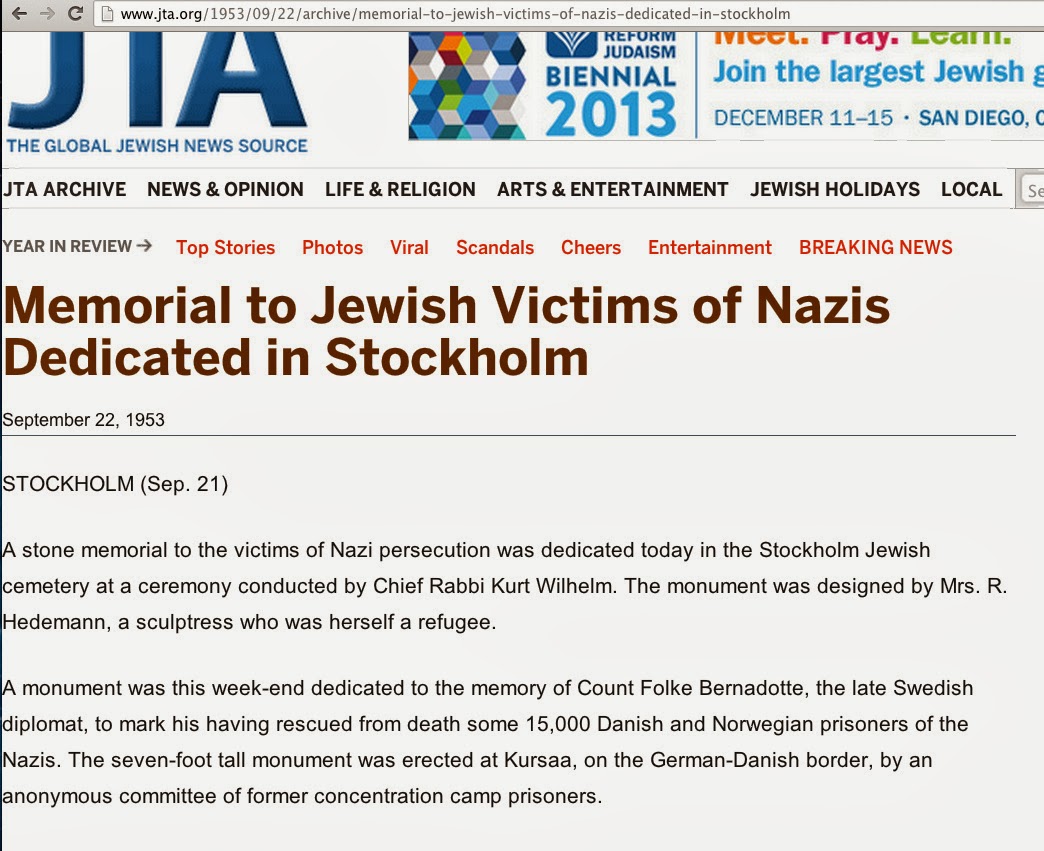  |
| Two stone memorials dedicated to the victims of Nazi persecution. Both are at the Stockholm Jewish cemetery Norra. The monument on the right with two wings (reminds of the Jesus statue or an angel) was designed by Mrs. R. Hedemann, a sculptress who was herself a refugee (from 1953). |
IMPORTANT: United States Holocaust Memorial Museum
The above-mentioned "Name list section" is in the Survivors Registry Collection as a computer file in MS Word document format, at S:\DATA\Reglists\Ab0018\Wrklist.doc [Available to authorized Survivors Registry staff only].
Denna fil i United States Holocaust Memorial Museum, tillkom på initiativ av Föreningen Förintelsens Minne och den första disketten överlämnades personligen i Washington av föreningens generalsekreterare Romuald Wroblewski.

